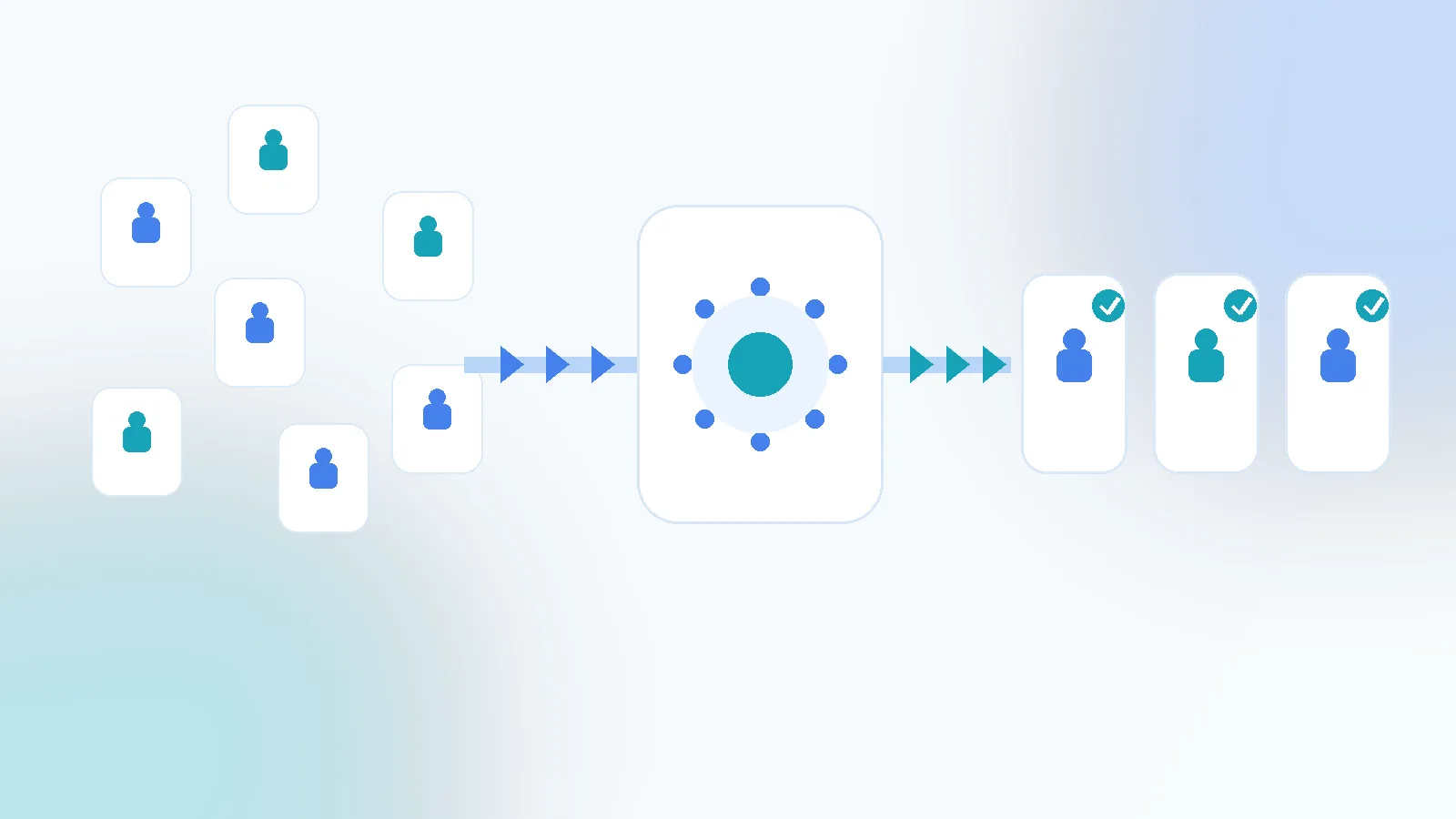

Recruiters do not need another tool that gives them more information.
They need a tool that helps them make sense of the applications already in front of them.
That is the real value of AI CV screening software.
A good tool should help recruiters move through applications faster, see why a profile may be relevant, and decide which candidates deserve closer attention.
It should not turn hiring into an automatic process.
The recruiter still needs to understand the profile and make the final decision.
What AI CV screening software should actually do
The basic idea is simple.
The recruiter provides the role requirements and candidate CVs. The software helps compare the two.
But useful screening goes beyond finding exact keywords.
A candidate may have the right experience without using the same words as the job description.
For example, a job may ask for:
Team leadership experience.
A CV may instead say:
Coordinated five developers across three client projects.
The wording is different, but the experience may still be relevant.
Good screening software should help surface that kind of evidence.
The goal is not to replace the recruiter’s judgment.
It is to make the first review faster and more consistent.
| Feature | Why it matters |
|---|---|
| CV analysis | Helps extract relevant candidate information quickly |
| Job matching | Connects candidate experience with role requirements |
| Candidate scoring | Helps prioritize profiles consistently |
| Clear reasoning | Explains why a candidate appears relevant |
| Missing information | Highlights points that still need to be checked |
| Human validation | Keeps the recruiter in control of the final decision |
A shortlist is useful only if you understand it
Many screening tools promise to rank candidates.
That can save time, but a ranking alone does not tell the recruiter much.
Imagine seeing:
Candidate A — 86%
Candidate B — 74%
The obvious reaction is to look at Candidate A first.
But the real questions are:
- Why did Candidate A score higher?
- Which requirements are clearly covered?
- What seems missing?
- Is the difference between the two candidates actually important?
Useful AI CV screening should make those answers visible.
Instead of giving only a number, the software should help the recruiter understand what supports the result.
That makes the shortlist easier to review and easier to challenge when needed.
Look for evidence, not just keyword matching
This is one of the most important things to check when evaluating a screening tool.
- A CV is not a database of perfect keywords.
- People describe similar experience in very different ways.
- A salesperson may write about account growth without using the phrase “customer relationship management.”
- A project manager may explain how they coordinated delivery without using the exact term “resource management.”
- A recruiter therefore needs more than a keyword filter.
The software should help connect the candidate’s actual experience with the role.
That does not mean the AI will always be right.
It means the result should give the recruiter something useful to review.
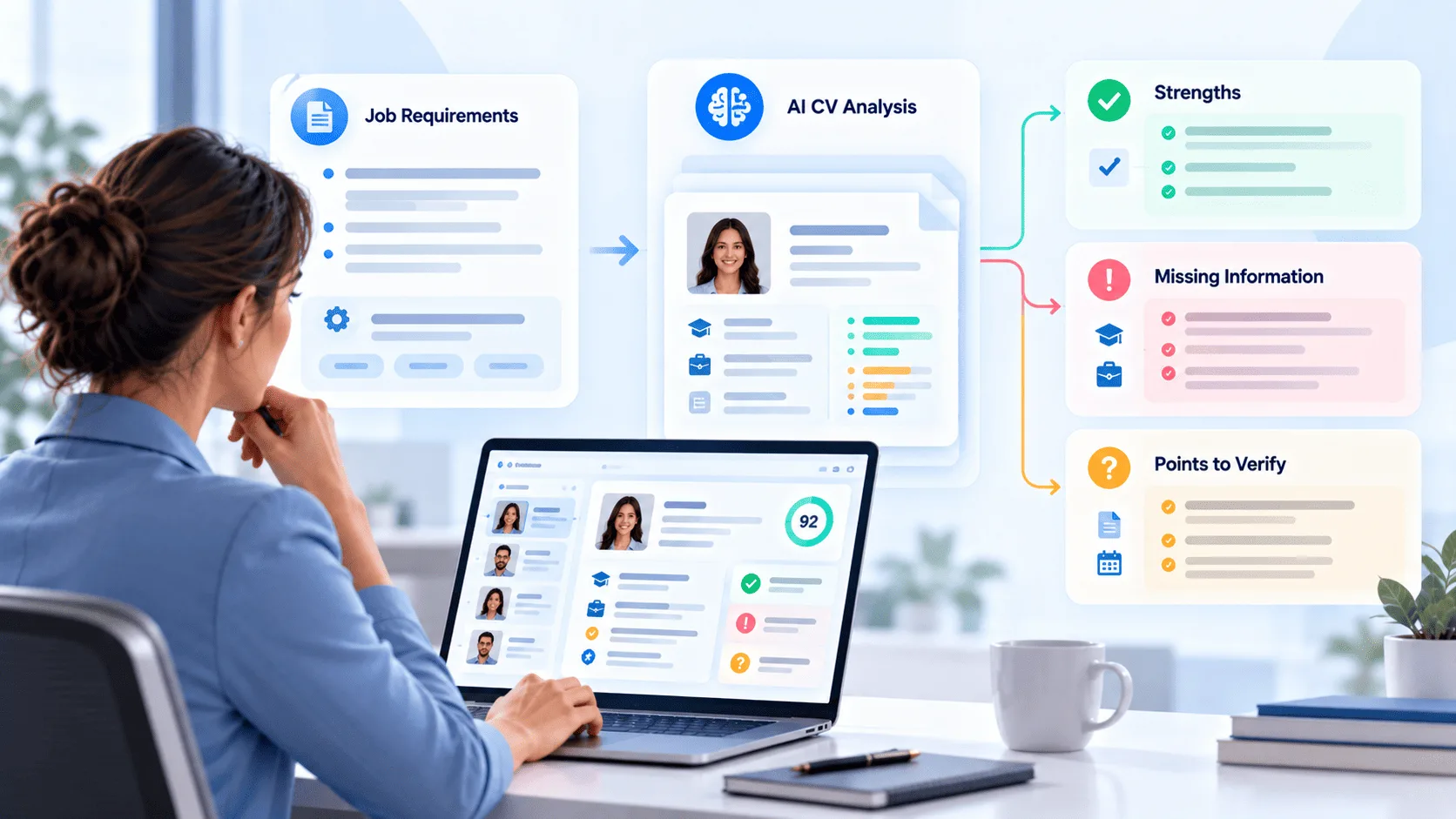
Missing information matters too
A good screening process should not pretend that every CV gives a complete answer.
Sometimes a candidate looks promising, but an important detail is unclear.
For example:
The role requires client-facing experience.
The candidate has strong technical experience, but the CV does not clearly mention client communication.
That should not automatically mean rejection.
It should simply mean:
This point needs to be checked.
That is useful information for the recruiter.
A screening tool becomes more valuable when it can help separate:
clear evidence, possible evidence, and missing information.
This gives the recruiter a better reason to open a CV instead of blindly trusting a ranking.
Human control should be built into the process
This is where companies should be careful.
AI can help review applications.
It can highlight information.
It can organize candidates.
But the recruiter should still be able to review the original CV and make the final decision.
A candidate should not become an automatic “yes” or “no” because of one score.
The recruiter may see something the system missed.
The job may also have context that is difficult to express in a job description.
That is why the best use of AI is as decision support, not as an automatic hiring decision.
The software helps.
The recruiter decides.
What to check before choosing a tool
Before choosing AI CV screening software, recruiters should focus less on the number of features and more on a few practical questions.
- Can recruiters understand why a candidate is considered relevant?
- Can they review the original CV easily?
- Does the system show missing or unclear information?
- Can a recruiter disagree with the result?
- Does the tool fit the current hiring process?
- Will it actually save time for the team?
These questions are more useful than a long feature list.
A tool can have many AI features and still create more work if recruiters do not trust the output.
The best test is simple:
Does this make the first review easier?
Screening should fit the way the team already recruits
A screening tool should not force the company to rebuild its entire hiring process.
Some teams already use an ATS.
Others work with shared folders, email, spreadsheets or internal HR tools.
The screening layer should fit into that reality.
This is especially important for smaller HR teams.
They may not need a large recruitment platform.
They may simply need a faster way to review CVs and identify relevant candidates.
The right tool depends on the workflow, not just the technology.
How Monark PEPIT approaches CV screening
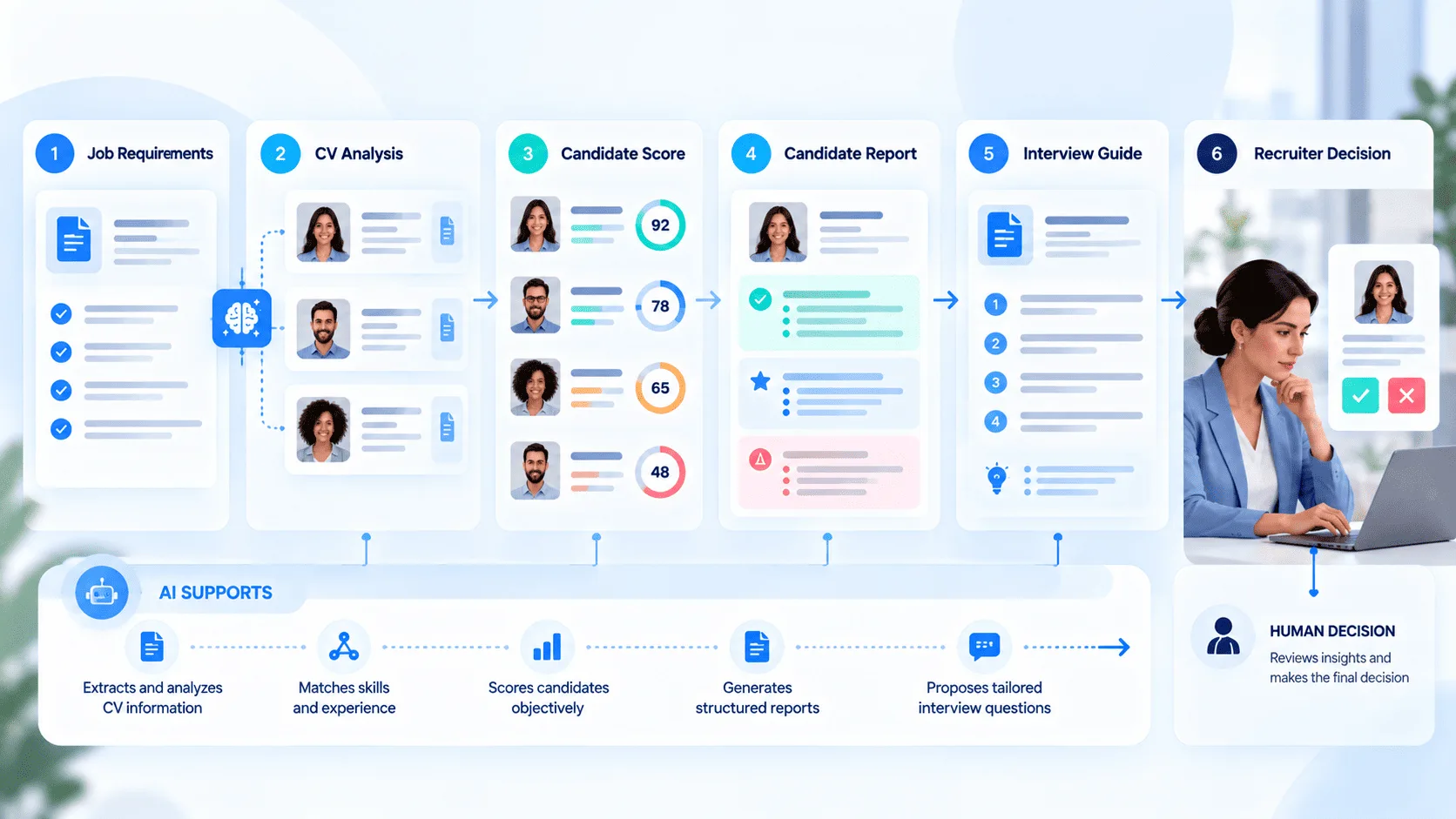
Monark PEPIT is designed to help recruiters review candidate profiles faster while keeping human control.
It can analyze a CV against the role requirements and help identify relevant experience, strengths and points that may need more attention.
The aim is not to make the hiring decision for the recruiter.
PEPIT helps reduce repetitive screening work and gives the recruiter a clearer starting point for reviewing candidates.
The recruiter can still review the profile, question the result and decide whether the candidate should move forward or be rejected.
That human decision remains part of the process.
Do not judge a screening tool only by speed
Speed is useful.
But screening twice as fast does not help much if recruiters no longer understand why candidates are being selected.
A good system should improve both:
speed and clarity.
The recruiter should be able to move through applications faster without losing sight of the evidence behind each profile.
That is a much better measure of value than simply counting how many CVs the AI can process.
When AI CV screening is most useful
AI screening is particularly useful when a team receives more applications than recruiters can comfortably review manually.
It can also help when several recruiters work on the same role and need a more consistent first review.
For a very small number of applications, manual screening may already be enough.
The value increases when repetition becomes a real problem.
That is why companies should start with the hiring challenge rather than with the AI itself.
A useful starting point is to identify where recruiters spend the most time in the current hiring process.
If repetitive CV review is one of the main bottlenecks, AI screening software may be a good place to start.
Final thoughts
Good AI CV screening software should make recruitment easier to understand, not more confusing.
It should help recruiters find relevant evidence, spot missing information and review applications faster.
The shortlist should be explainable.
The recruiter should be able to challenge it.
And the final decision should remain human.
The goal is simple:
less repetitive CV review, more time for useful recruiter judgment.
FAQ
What is AI CV screening software?
AI CV screening software helps recruiters review candidate CVs against role requirements and identify profiles that may deserve closer attention.
Is AI CV screening just keyword matching?
It should not be. Better tools look for evidence related to the job requirements, even when candidates use different wording.
Can AI CV screening automatically reject candidates?
AI can support screening, but meaningful human review should remain part of the hiring process.
What should recruiters look for in AI CV screening software?
Look for clear reasoning, useful matching, visibility into missing information, recruiter control and a workflow that fits your existing hiring process.
How does Monark PEPIT help?
Monark PEPIT supports recruiters by analyzing candidate profiles against role requirements and helping make the first screening easier to review. The recruiter remains responsible for accepting or rejecting the candidate.
Discover MONARK PEPIT, AI-powered CV screening and interview preparation for recruiters.