

How can recruiters prepare better interviews without turning every conversation into the same list of generic questions?
The answer is to prepare around three things: what the role requires, what the candidate has already shown, and what still needs to be verified.
A good interview guide gives recruiters enough structure to compare candidates while still leaving room to explore each person’s experience.
It should not feel like a rigid script.
Instead, it should help the recruiter understand what needs to be learned during the interview.
This difference matters.
A recruiter who simply asks the same ten questions may finish the meeting with many notes but little useful evidence. A recruiter who prepares questions around the role and the candidate can use the same time to clarify skills, experience, responsibilities and areas of doubt.
The result is a better conversation and a more useful assessment.
Why better candidate interviews start before the meeting
The quality of a candidate interview depends heavily on the preparation done before the interview begins.
In many hiring processes, the recruiter reads the CV quickly before the meeting and then starts with familiar questions.
- “Can you tell me about yourself?”
- “Why are you interested in this role?”
- “What are your strengths?”
These questions can help start a conversation. But they rarely provide enough evidence to decide whether the person fits the role.
Before the interview starts, the recruiter should already know what needs to be checked.
Imagine you are recruiting a project manager.
The role requires experience managing several projects, coordinating teams, handling changing priorities and reporting to clients.
A candidate writes on the CV that they have five years of project management experience.
That is useful, but it is not enough.
- Did the person manage one project or several projects at the same time?
- How large were the teams?
- Did they manage budgets?
- Did they work directly with clients?
- What happened when deadlines changed?
- How did they organize project reporting?
These are the questions that turn a CV into something the recruiter can really assess.
The best interview preparation starts in the space between what the job requires and what the CV already tells you.
Build the interview from the role, the CV and the unknowns
A strong interview can be prepared from three simple sources.
The first is the job itself.
Before reviewing candidates, the recruiter should understand what really matters for the role.
A job description can contain many requirements, but not all of them have the same importance.
For example, a role may require technical skills, experience with clients, team management, problem solving and a certain level of autonomy.
The recruiter should identify the criteria that will have the biggest impact on success in the role.
This gives the interview a clear purpose.
The second source is the candidate’s CV.
The goal is not to ask the candidate to repeat the CV line by line.
The CV should instead help identify areas that deserve more detail.
Suppose a candidate writes:
Managed a team of 12 people.
A basic interview question might be:
Can you tell me more about that role?
A more useful question would be:
What were you personally responsible for when managing that team?
The recruiter can then continue with simple follow-up questions.
- How was the work divided?
- What was the hardest team problem?
- How did you deal with it?
- How did you measure whether the team was performing well?
The CV gives you the starting point. The interview helps you understand what the candidate actually did.
The third source is missing information.
Sometimes the most useful interview questions come from what is not clear.
A candidate may have strong technical experience but no clear evidence of working with customers.
If customer communication matters for the role, that becomes something the interview should explore.
The same applies to unclear responsibilities, short assignments, employment gaps or major career changes.
The goal is not to search for problems.
The goal is to remove uncertainty.

Use the same core structure for every candidate
Candidate-specific questions are useful, but recruiters still need a common structure.
If one candidate receives detailed technical questions while another spends most of the meeting discussing general career goals, comparing them later becomes difficult.
This is why structured interviews are useful.
The interview does not need to be identical for everyone. But the key criteria should remain consistent.
A simple interview structure can include four parts:
| Stage | Purpose |
|---|---|
| Opening | Explain the role, meeting and interview format |
| Core questions | Assess the same important criteria for every candidate |
| Candidate-specific questions | Explore points from the CV that need more detail |
| Closing | Answer candidate questions and explain next steps |
This combination gives recruiters both consistency and flexibility.
The common questions make comparison easier.
The personalized questions help recruiters understand each profile in more depth.
Keep the opening short and clear
An interview does not need a long introduction.
The recruiter can simply explain who is taking part, what will be discussed and how long the interview should take.
This gives the candidate some context and makes the conversation easier to follow.
A simple introduction might be:
We will start with your recent experience, then discuss a few parts of the role in more detail. I also have some questions related to your CV, and we will leave time at the end for your questions.
The candidate knows what to expect.
The recruiter can then move quickly into useful discussion.
Ask core questions that match the role
Each candidate should have a fair opportunity to show evidence for the most important requirements.
- If leadership is essential, every candidate should be asked about leadership.
- If client communication matters, every candidate should be asked about client communication.
- If technical decision-making matters, every candidate should have a chance to explain a real technical decision.
The wording does not have to be identical every time.
What matters is that the same core criteria are assessed.
This makes the final comparison much stronger.
Instead of saying:
Candidate A felt stronger.
the recruiter can say:
Candidate A gave stronger evidence of managing several projects at the same time, while Candidate B showed more experience in client communication.
That is a much more useful hiring discussion.
Add questions based on the individual CV
This is where the interview becomes personal to the candidate.
Two people applying for the same role may need different follow-up questions.
One candidate may have strong leadership experience but limited information about budgets.
Another may have strong technical experience but no clear evidence of managing teams.
A third may have changed industries and need to explain how previous experience transfers to the new role.
The recruiter should use the interview to explore those differences.
This does not mean changing the evaluation criteria.
It means finding the right questions to collect the evidence needed for those criteria.
Ask for evidence, not only opinions
There is a big difference between asking:
Are you good at dealing with difficult clients?
and:
Tell me about a difficult client situation you handled. What happened, what did you do and what was the result?
The first question makes it easy for the candidate to say yes.
The second asks for a real example.
Strong interview questions encourage candidates to explain situations, actions and results.
- A recruiter can then use short follow-up questions such as:
- What was your role?
- What did you do personally?
- Why did you choose that approach?
- What went wrong?
- What would you do differently today?
- What was the final result?
These simple questions often provide more value than asking many unrelated questions.
Use an interview scorecard to keep the assessment clear
After several interviews, it becomes easy to forget details.
One candidate seemed technically strong.
Another had good communication.
A third appeared experienced.
But these impressions can become difficult to compare.
An interview scorecard gives the recruiter a simple structure.
For example:
| Criterion | Score |
|---|---|
| Relevant experience | 1–5 |
| Required skills | 1–5 |
| Problem solving | 1–5 |
| Communication | 1–5 |
| Role-specific requirement | 1–5 |
The number should never be the only information recorded.
A short explanation is more useful.
Instead of writing:
Relevant experience: 4/5
write:
Relevant experience: 4/5 — managed three similar projects and gave a clear example of dealing with a delayed delivery.
Now the score has context.
The hiring team can understand why the recruiter gave it.
How AI can help recruiters prepare better interviews
AI can reduce the time needed to prepare interviews, especially when recruiters handle many applications.
The useful role of AI is not to decide who should be hired.
It is to help organize information and prepare the recruiter.
An AI recruitment tool can compare a candidate’s CV with the job description and highlight areas such as relevant skills, experience, strengths and missing information.
From there, it can help prepare questions.
Imagine that the job requires React experience, team leadership and regular communication with clients.
The candidate clearly shows React experience and team leadership.
However, the CV says almost nothing about working directly with clients.
That becomes an important point to explore.
A useful question might be:
Can you describe a situation where you had to explain a technical decision directly to a client?
This question is more useful than simply asking:
Are you comfortable working with clients?
The first asks for evidence.
The second mainly asks for an opinion.
AI can help identify these opportunities quickly.
The recruiter still decides which questions to use and how much weight to give each answer.
How Monark PEPIT supports interview preparation
Monark PEPIT connects CV analysis, candidate scoring and interview preparation in the same recruitment flow.
PEPIT starts by analyzing the candidate’s CV against the job requirements.
It can help identify relevant experience, skills, strong signals and points that may need more clarification.
Instead of stopping after the CV score, PEPIT uses that context to help prepare the next step.
The platform can generate a tailored interview guide with candidate-specific questions based on the candidate profile and the role.
For example, if the CV shows strong technical experience but little information about project ownership, the interview guide can include questions designed to clarify that point.
If a candidate has managed teams but the level of responsibility is unclear, PEPIT can suggest questions around team size, decision-making and daily responsibilities.
If an important job requirement is missing from the CV, the recruiter can use the interview to check whether the candidate has relevant experience that simply was not described.
The goal is simple.
PEPIT helps the recruiter understand what should be checked during the interview.
The generated questions are not meant to replace the recruiter.
They provide a starting point.
The recruiter remains free to select the useful questions, ask follow-up questions and adapt the conversation based on the candidate’s answers.
This makes the interview guide more useful than a generic list of questions.
It is based on the actual relationship between the job requirements and the candidate profile.
PEPIT can therefore support a recruitment workflow that moves naturally from:
CV analysis → Candidate scoring → Candidate report → Interview guide → Recruiter evaluation
The hiring decision remains with the recruiter and the hiring team.
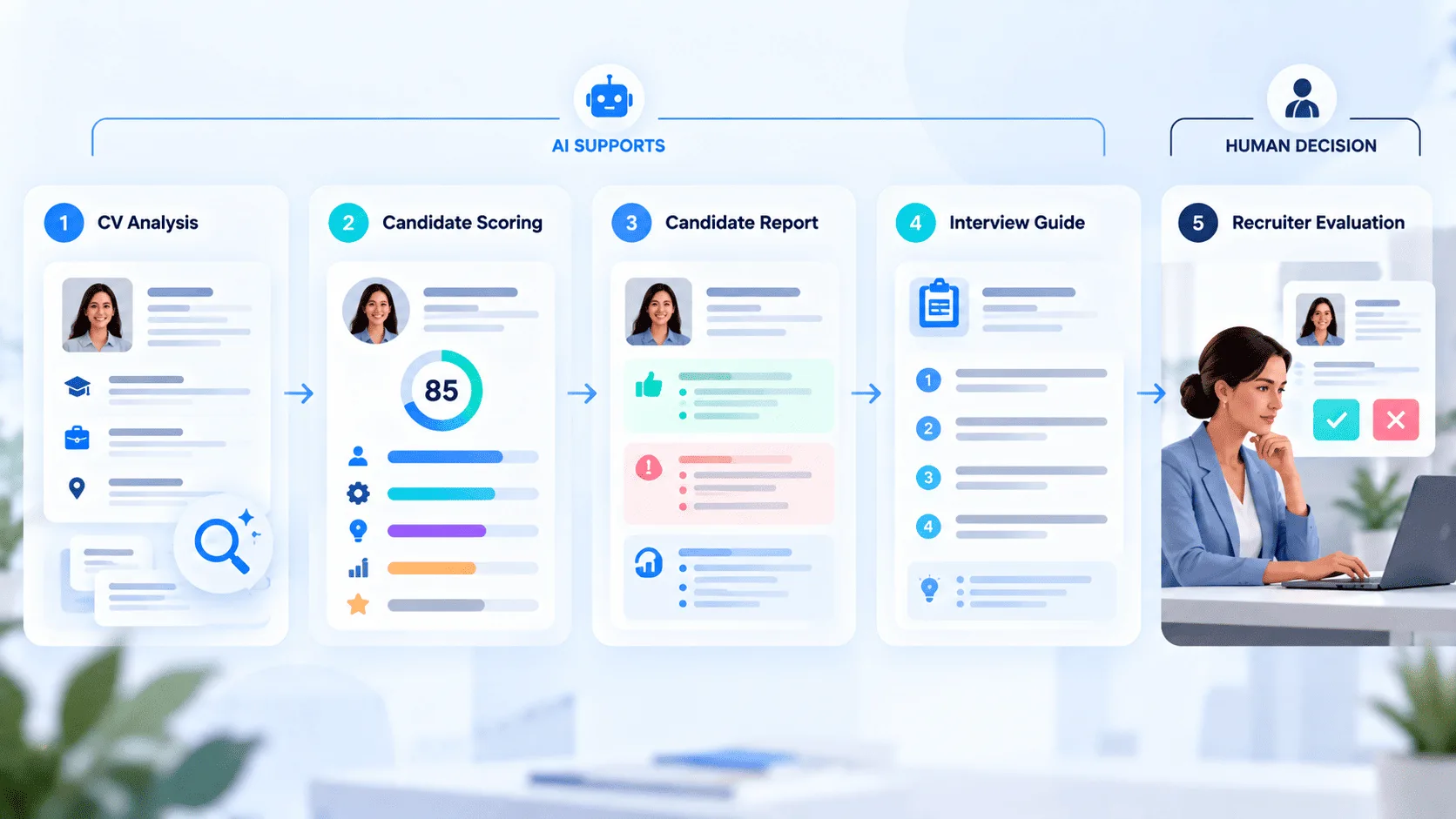
A simple workflow from CV review to candidate interview
A clear recruitment workflow can stay simple:
1. Define the job requirements
Identify the skills, experience and responsibilities that matter most.
2. Review the candidate CV
Look for relevant evidence, strengths and missing information.
3. Prepare the interview
Combine core questions with questions specific to the candidate.
4. Conduct the interview
Ask for examples, use follow-up questions and record useful evidence.
5. Update the candidate assessment
Use what you learned during the interview to refine the initial evaluation.
The interview guide should support the conversation, not control it.
Better interviews create better final discussions
The value of structured interview preparation becomes even clearer after the interviews are finished.
Without clear criteria, hiring discussions often become subjective.
One person says:
I really liked Candidate A.
Another says:
Candidate B seemed stronger.
This does not give the team much to work with.
With a structured process, the discussion changes.
The team can compare candidates against the role.
Which candidate showed stronger evidence for the required experience?
Which candidate handled the problem-solving example better?
Which candidate still has important gaps?
Which points were clarified during the interview?
The final discussion becomes based on evidence rather than memory alone.
That does not remove human judgment.
It makes human judgment easier to explain.
Recruiter checklist before the interview
Before starting the meeting, check these points:
- Do I know the most important requirements of the role?
- Have I reviewed the candidate’s CV?
- Do I know what information is still missing?
- Do I have a small set of questions that every candidate receives?
- Do I have candidate-specific questions?
- Do I know how I will evaluate the answers?
- Do I have a place to record evidence and notes?
- Do I know what the next step will be?
If these questions have clear answers, the interview is usually easier to run.
Final thoughts
A good interview is not created by asking more questions.
It comes from asking the right questions for the role and the candidate.
The job description tells you what matters.
The CV tells you what the candidate claims.
The interview helps you verify the evidence and understand what is still unclear.
A structured interview guide brings these pieces together.
AI can make the preparation faster, but the recruiter should remain responsible for the conversation and the final assessment.
Tools such as Monark PEPIT can support this process by connecting CV analysis, candidate scoring and personalized interview preparation.
The result is not an automated hiring decision.
It is a recruiter who arrives at the interview with better context, clearer questions and more useful information to guide the final decision.
FAQ
What is an interview guide?
An interview guide is a structured set of topics, questions and evaluation criteria used to help recruiters conduct consistent and useful candidate interviews.
What should a recruiter prepare before interviewing a candidate?
The recruiter should understand the job requirements, review the CV, identify missing information and prepare both common and candidate-specific questions.
Should every candidate receive the same interview questions?
The main questions should usually remain consistent when they assess key job requirements. Additional questions can be adapted to each candidate’s experience and CV.
How many interview questions should a recruiter prepare?
There is no fixed number. A small number of relevant questions with good follow-up is often more useful than a long list of generic questions.
What is an interview scorecard?
An interview scorecard is a simple way to evaluate candidates against predefined criteria. Each score should include a short explanation based on evidence from the interview.
Can AI prepare interview questions?
Yes. AI can use the job description and candidate profile to suggest relevant questions, especially around experience, skills and areas that need clarification.
How does Monark PEPIT help prepare interviews?
Monark PEPIT analyzes the candidate profile and job requirements, then helps identify points to verify and generates a tailored interview guide with candidate-specific questions.
Can AI replace the recruiter in an interview?
AI can help with preparation, analysis and question generation, but the recruiter should conduct the conversation, evaluate context and remain responsible for the final hiring decision.
Discover MONARK PEPIT, AI-powered CV screening and interview preparation for recruiters.