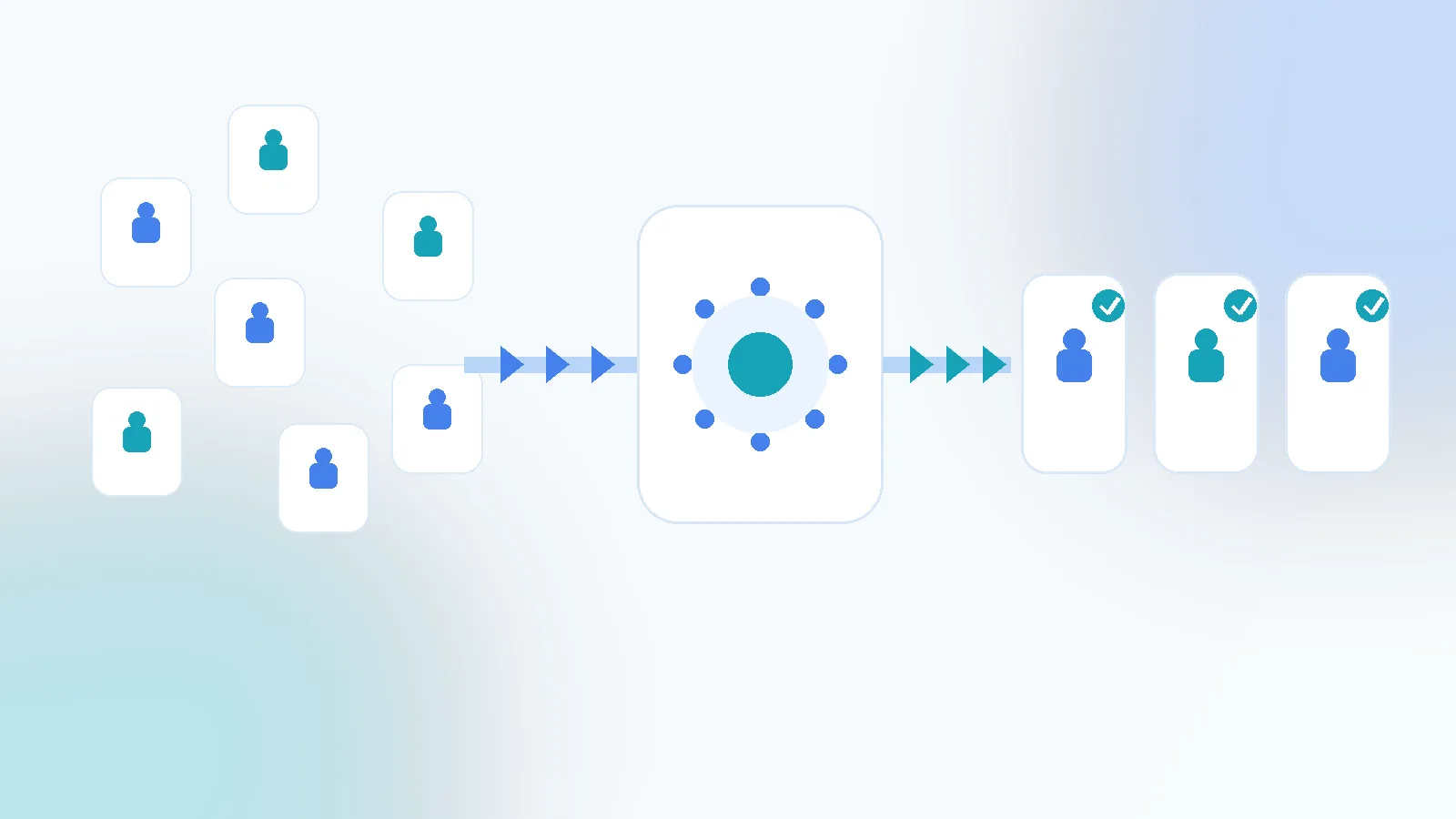

What actually happens when AI analyzes a CV, and how does that analysis become a candidate score?
AI CV analysis first extracts and structures information such as experience, skills and education from the resume. It then compares that structured information with the requirements of a specific role. The result is not only a score, but an explained assessment showing job fit, identified strengths and points the recruiter may want to explore during the interview.
What actually happens when a resume gets reviewed by AI?
The process starts with automatic extraction of the information contained in the document: experience, skills, education, keywords relevant to the target role. This step alone isn't enough to judge a candidate, it simply structures information that, on paper, is often presented very differently from one resume to the next. That structuring is what then enables a real comparison between candidates, rather than a sequential read where each resume gets judged in isolation.
| Stage | What happens |
|---|---|
| 1. Extraction | Experience, skills, education and relevant information are identified |
| 2. Structuring | Resume information is organized into a consistent candidate profile |
| 3. Comparison | The profile is compared with the requirements of the target role |
| 4. Scoring | Job fit, strengths and points to explore are evaluated |
| 5. Recruiter review | The recruiter sees the score and the reasoning behind it |
What does CV analysis actually extract from a resume?
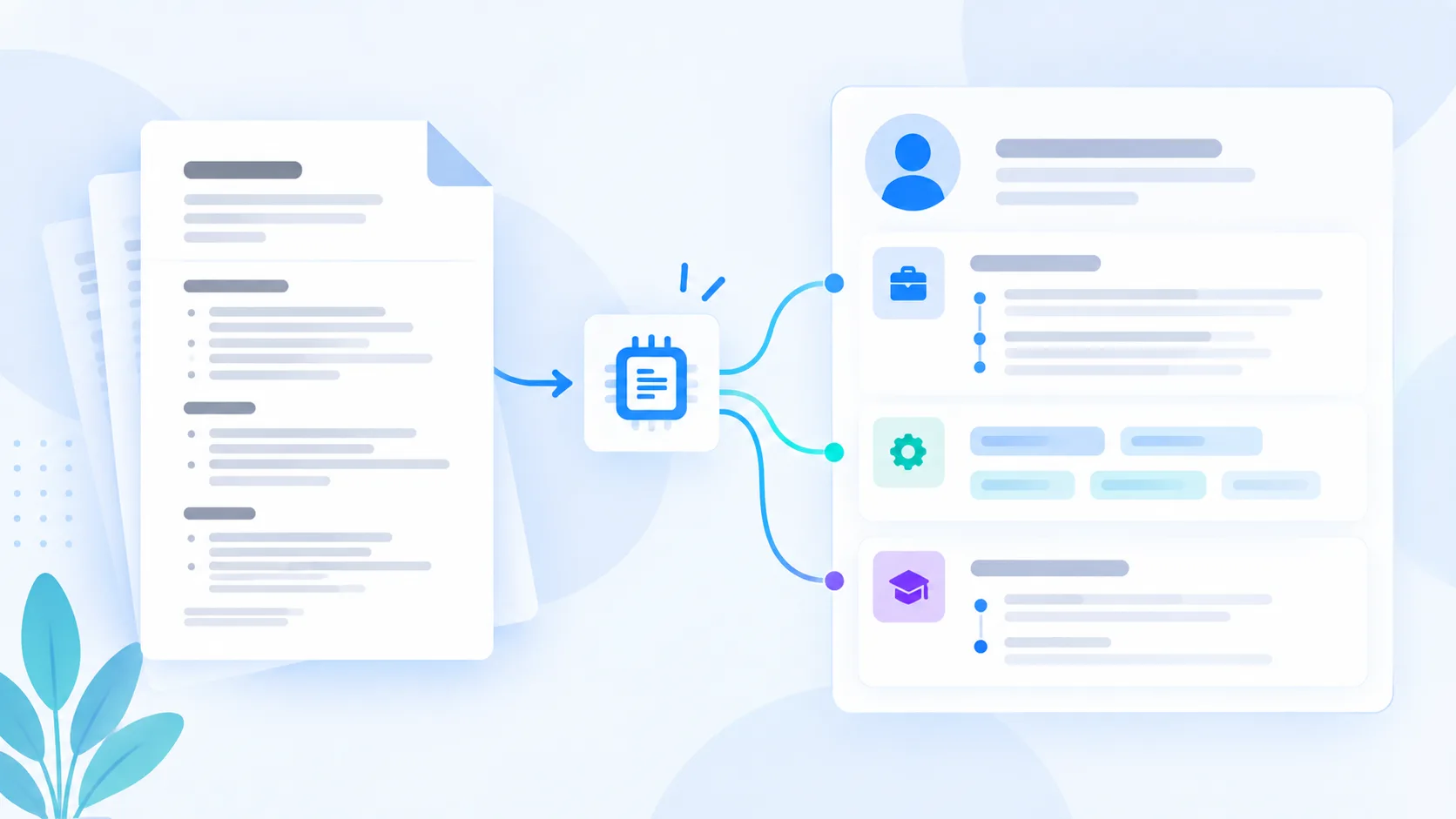
The extraction goes beyond just pulling keywords off the page. Work history gets parsed into distinct roles with duration and responsibilities, education gets identified separately from professional experience, and specific skills get isolated from the surrounding text they're embedded in. A resume written as a dense paragraph and one built with clear sections end up producing the same kind of structured output, which is what makes comparing two very differently formatted resumes possible in the first place.
Why does structuring the resume matter before scoring?
Without this step, any scoring attempt would just be reading raw text and guessing at relevance, which is close to what a keyword filter does and exactly the kind of shortcut that produces unreliable results. Structuring first means the scoring stage has something precise to evaluate: a defined role history to compare against seniority requirements, a defined skill set to compare against the job's actual needs, not a wall of text hoping the right words appear somewhere in it.
How is the score actually calculated?
This is the most important part to understand. Good candidate scoring doesn't settle for a single number: it weighs job fit, strengths identified in the candidate's background, and points worth digging into during the interview. Recruiters see not just the score, but the reasoning behind it, which completely changes how much trust you can place in the result compared to a plain percentage with no explanation attached.

Does the analysis account for different resume formats?
Extraction works best with standard structured formats, mainly text-based PDFs where the underlying content can be read directly. Heavily graphic resumes, or scanned image files, are harder to parse reliably and may need additional manual review to confirm nothing important got missed. This is a real limitation worth knowing about rather than a hidden gap discovered too late.
Does this replace the recruiter's own reading?
No, and that's a deliberate design choice for this kind of tool. The AI acts as a fast, consistent first filter, not a final decision-maker. Recruiters keep full control over every decision, with the advantage of starting from an already sorted and explained pool of candidates, rather than a pile of unranked resumes to read in whatever order they landed in the inbox.
How does CV analysis connect to the rest of the screening pipeline?
CV analysis doesn't run as an isolated step. It depends on ATS integration to receive each application automatically as it comes in, structure it, and feed it into scoring without anyone needing to export or re-upload anything. Without that connection, the analysis itself would still work, but someone would have to manually feed it resumes one at a time, which defeats most of the time saved.
What Monark Pepit does at this exact stage
Monark Pepit follows a five-step pipeline: resume submission, data extraction, AI scoring, report generation, and notification. The resulting score always comes with a detailed justification, never displayed alone, along with an automatically generated interview guide to prepare the next step without improvising questions at the last minute.
Common misconceptions about AI CV review
The biggest one is assuming the tool is just reading for keywords, the way older applicant filters used to. Structured extraction and contextual scoring are a different approach entirely, closer to how a careful human reader would parse a resume than to a simple word match. Another common misconception is that a lower score means a candidate should be dropped automatically, when it's really meant as a prompt to check the reasoning before deciding anything.
Common mistakes when relying on CV analysis
Skipping the reasoning behind a score and only looking at the number is the most frequent one, since it throws away exactly the part that makes the tool trustworthy. Feeding the system a vague or incomplete job description is another, since the analysis can only evaluate fit against what it was actually given. And treating heavily formatted or scanned resumes as reliably analyzed without a manual check can let real gaps slip through unnoticed.
Does this fit into a broader HR tools setup?
Yes. CV analysis isn't meant to stand alone as a full recruiting solution, it's one layer inside a wider set of HR tools that also covers interview preparation, candidate communication, and tracking. Its job is narrow and specific: turn an unstructured resume into something the rest of the process can actually work with.
FAQ
Does AI CV review work with every resume format?
Extraction works best with standard structured formats (text-based PDFs). Heavily graphic or scanned image resumes may need additional manual review.
How long does it take to review a batch of resumes?
Automated processing is fast, typically a few minutes for a full batch, compared to several hours of manual reading for the same volume.
Does the score change depending on the target role?
Yes, that's actually the main point: the score is calculated against a specific job description, not generically, so the same resume can get different scores depending on the role in question.
Can CV analysis miss important details in a resume?
It can, particularly with heavily graphic or scanned formats. That's why results stay visible and checkable rather than hidden, so a recruiter can confirm details on any profile that looks uncertain.
Is CV analysis only useful for high-volume hiring?
It helps most where volume is highest, but the consistency it brings, evaluating every resume against the same structured criteria, is useful even for a handful of applications per role.
Discover MONARK PEPIT, AI-powered CV screening and interview preparation for recruiters.